The origins: the Abbey of Sestinga
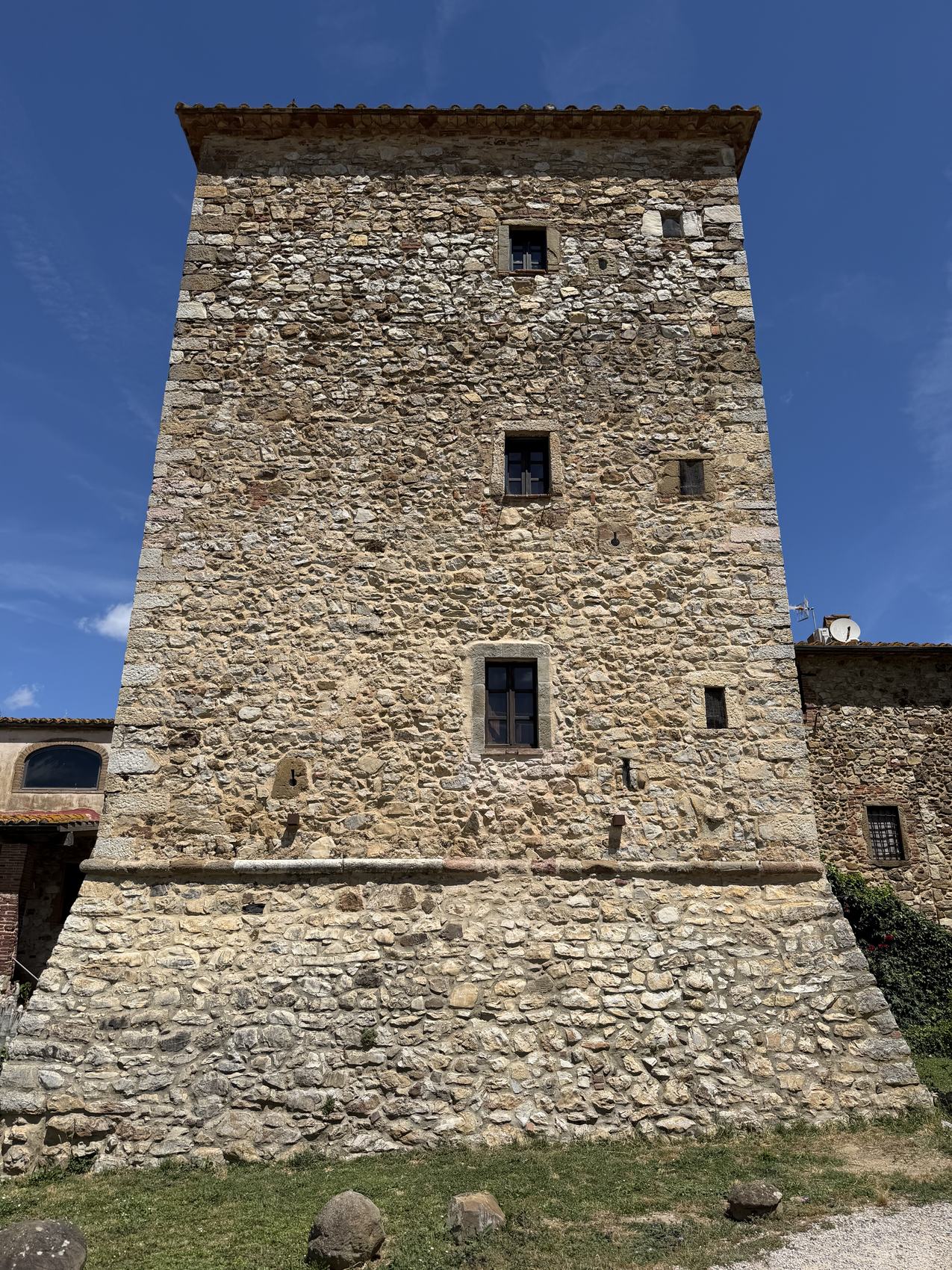
Torre di Casallia rises below ancient Etruscan Vetulonia, in a commanding position over the plain of the Grosseto Maremma. Its origins date back to around the year 1000, when it was built as the bell tower of a small Benedictine monastery, dependent on the more important Abbey of Sestinga. It was a place of prayer and observation, its height allowing the monastic community to mark time and keep watch over the plain below.
The Aldobrandeschi County: from bell tower to castle
As the monks moved on, the tower came under the Aldobrandeschi County, the vast feudal domain that ruled the Tuscan Maremma between the 1200s and 1300s. It was in this phase that the structure was transformed from a bell tower into a true castle: the two most recognizable elements of the tower date to this period — the scarp, the trapezoidal base that widens and reinforces the foundations, and the white marble arrow-slits, still perfectly legible against the grey stone facing today, once used for bow and crossbow. The Lambardi, a family tied to the Aldobrandeschi, were protagonists of this castle phase of the tower.
The Sienese conquest and the great families
Only after Siena's conquest of Grosseto did the territory, and the tower with it, come under the control of the Republic of Siena. From this point on, the tower entered the orbit of some of the most important Sienese families: the Tolomei — the same house to which Dante's tradition ties the figure of Pia de' Tolomei — the Austini, who according to the most credited reconstruction entered the chain of ownership before the Bichi, and finally the Chigi. Each family left its mark on the structure and on its documentary history, in a web that reflects the political and territorial events of the Sienese Maremma between the late Middle Ages and the early modern period.
The 18th century: the timber roof
A significant intervention dates to the 18th century, when the tower — already seven centuries old — received a new timber-truss roof, still in use today on the building's top level. Sleeping beneath those beams means finding yourself, quite literally, inside a thousand years of layered construction: from the 13th-century masonry to the 18th-century timberwork, down to the most recent interventions.
21st century: restoration and rebirth
After centuries of transformations that had gradually taken it away from its original form, the tower underwent a full restoration, carried out with complete respect for its historical and architectural layering. The local stone facing, the marble arrow-slits, the medieval vaults, the period fireplace and the structure of the 18th-century roof were all recovered. The comfort — heating, equipped kitchens, contemporary bathrooms — is that of today. The soul has remained the same as always.
From this restoration come two independent apartments, Ildebrando and Pia de' Tolomei, which bring the tower back to life while keeping its memory intact — and which can also become, for those who wish it, a single home across four floors.